
Archive for the ‘food’ Category

British Pie Week

It’s British Pie Week from the 5th to the 11th March (2012), earlier this year we posted about National Pie Day, so if you’re interested in some quick pie-related facts check out our previous blog post here.

The British Pie Week website (hosted by General Mills Inc.) has announced their “Pub Pie Champion for 2012″.  Drum roll… It’s (chef) hats off to Carol Haime at The Sandrock, Farnham, with a delicious “Wheatley House Pheasant Pie with baby parsnips, juniper and a poppy seed and rock salt crust!” Becoming the first woman to win the competition, Carol said “It’s fantastic to have won! I don’t think it’s really sunk in yet. The whole team is delighted and we’re really looking forward to celebrating during British Pie Week.”
(Source www.britishpieweek.com. The recipie for Carol’s winning pie is also available here.)

The marriage between pies and British pubs is long standing and legendary, searching the comments on BITE we discovered the following pie’scentric pubs recommended by you, our users. These pubs have gone to greater lengths to produce pies worthy of our attention as pub patrons. (Pub suggestions are based on pub-page activity within the last 12 months.)

The Brie Louise, Euston, London: While the reviews from users who have dined on The Brie’s pies seem mixed, there’s no mistaking that The Brie has won awards for it’s skills in pie making. Their Steak & Kidney pie is a crowning achievement  having scooped three consecutive annual awards, a medal has also been pinned on their seasonal Turkey, Cranberry & Stuffing pie (only available in the winter months).   The Brie Louise offers a decent range of home cooked pies, including vegetarian and fish options.

Sweeney & Todd, Reading: The sign above the door blazons the title ‘Famous Pies, Famous Ales’. Knowing the story of Sweeney Todd and the recent findings that his murderous antics were no urban myth, we’re curious as to what ingredients are used in the Sweeney’s pies… Corporate bankers? Estate agents? Expense swindling Politicians? Jokes aside, the Sweeney & Todd boasts what we all want in a pub – friendly staff, reasonably priced well stocked real ales, and a curious selection of pie fillings, … Hare & Cherry anyone? The Sweeney & Todd pie fillings cater to both meat lovers and vegetarians alike.

The Raven, Bath: Described as a “hidden gem”, The Raven in Bath offers a wide selection of ever changing pie fillings, it all depends on which season you find yourself musing their menu. Classic ingredients, such as pork, steak, lamb are all locally sourced, with vegetarian options that may even tempt a browsing carnivore. The Raven also has it’s own specially brewed Real Ale (Raven Ale), when pubs go that extra yard and get it right, The Raven, Bath is worth mentioning.

The Prince of Wales, Ledbury: Tucked away off the Ledbury High-Street, the Prince of Wales is a proper old-fashioned British boozer.  With a relaxed, ambient, atmosphere it’s the perfect setting to sit back, enjoy a real ale from their wide selection and tuck into an enormous portion of their home cooked pie.  Check out their pie board when entering, it’s ever changing with the seasons, the Prince’s pies are baked using locally sourced ingredients.

The Kenton, Homerton, London: It’s a coin-toss about this entry, granted The Kenton doesn’t bake it’s own pies.  However, by word-of-mouth the quality of the Pieminister pies served at The Kenton has reached us on a number of occasions while hunger struck and wandering in Hackney.  This Norwegian run, grand, Victorian pub caters for all tastes, that means you, vegetarians and fussy eaters. The ‘Minty Lamb Pie’ is always a firm favourite to expel those stomach-rumbles, with nice selection of ales to accompany any pie you chose.

Just to finish off, The Angel at Stoke by Nayland, Colchester is offering a special pie and pint menu between the 5th and 11th of March, everyday a choice of pies will be on the menu, baked to perfection by The Angel’s resident top chef.  Booking during British Pie Week (5th – 11th March) is advisable so you can be guaranteed a piece of the pie(s).

If you’ve a favourite pie filling, a recipe for pie success or you know of a pub worth mentioning for it’s culinary pie abilities do let us know in our comments section below or by joining the conversation on our Facebook page.
National Pie Day 2012It’s National Pie Day 2012 today (23rd January), celebrating the heritage of pies.  The history of pies starts in ancient Egypt.  The Egyptians would bake fruits, nuts and honey into a form of pastry, those first pie incarnations were not necessarily much like the pies we know today.  It was then the ancient Greeks who should be attributed with the invention of the pie; they would bake various fillings both sweet and savoury into a pastry casing.  The Romans saw the potential of the pie and adopted it into their diet, bringing it with them in their conquest of Europe, so it’s the Romans who truly brought the pie to Britain when they landed on our shores.

In medieval Britain the pie was often the centre piece of the meal, filled with exotic fillings such as swans, peacocks and blackbirds (which you may remember from the nursery rhyme).  From the finest London restaurants to the wind swept terraces of football grounds, the pie has since become a stoic dish on the British menu, engraved into our popular culture. The chant “who ate all the pies?!” for example was first sung by Sheffield supporters in 1894 and directed at their clubs goalkeeper at the time William “Fatty” Foulke, an enormous man in stature.

Still lovingly associated with home cooked tradition and British pubs, the pie is here to stay.  Get down your local and demand a pie today!  If you’ve any comments feel free to leave them in our comments section below or join the conversation on our Facebook page. Cheers!
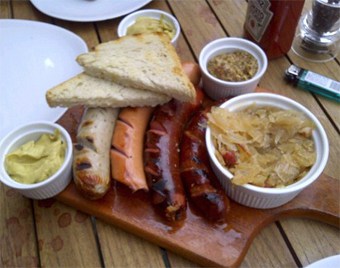
Sausage Week 2011British Pub Week 2011 is already in full swing, if you haven’t already spread the word, get down your local pub and show some support.  British Pub Week 2011 this year also coincides with another Great British national week “National Sausage Week 2011” running from the 2nd to the 8th Nov.  With an astonishing 400 unique varieties of sausage produced in the UK there’s plenty of sausage to choose from.  Get down your local pub demand some sausage, and beer, and amaze your friends with your knowledge of the sausage…

Quick Sausage’y facts

1. The sausage is an ancient form of food, pre-dating most historical cultures, the Sumerians were believed to have cooked the first sausages over 5,000 years ago.

2. The slang word for sausages “banger” was adopted during the second world war. Due to a lack of ingredients sausage makers would add water to their sausage recipe, when the water turned to steam inside the sausage skin, it would often explode with a “bang!”

3. The worlds longest sausage weighed in at 15.5 tonnes, and measured 35miles long. Unfortunately never officially adjudicated by the Guinness World records – who recognise a measly 1,500m German sausage as the record holder, our British 35 mile long masterpiece will not be forgotten.

4. Sausages are a product of efficient butchery.  Butchers use parts of the pig that are both edible and nutritious to make sausages, these ‘parts’ including organs, blood and fat would normally go to waste, seen as unsavoury by consumers, wrap it all up in a sausage format and you’ve got Britains number one home cooked meal.

5. The Frankfurter was a sausage made by a German butcher in the image of his pet Dachshund (sausage dog), in 1906, American cartoonist Ted Dorgan produced a painting of a dog in a bread roll covered in mustard to commemorate the German butchers sausage invention, unable to spell Dachshund Ted called it “hot dog”.  The name seemed to stick.

If you’re in the Twickenham area, you might want to get yourself down to the Rifleman they have organised a Beer, Cider and Sausage Festival. If you’ve got any sausage facts, recipies or just want to talk sausage leave a comment in our comments section below or join in the conversation on our Facebook page. Cheers!
Food Safety WeekThis week the Food Standards Agency is raising awareness of hygiene in the home with  Food Safety Week (Germ Watch), running from today 6th June to the 12th of June 2011.  Hygiene and cleanliness is high on the agenda for many of our BITE users, quite often we recieve comments regarding the cleanliness, or lack of, in the pubs BITE users visit.  But how much do you really know about food hygiene?  How much do you really abide hygiene advice when you are in your own home?

The Food Standards Agency has released a handy food hygene myths test, click here for the PDF. The FSA material will help you dispel some of the common myths surrounding food hygiene and teach us all a few things we might not yet know about safe food preparation. 

BBC Health reports that there are up to 9 million cases of gastroenteritis each year in the UK, that’s around 14 percent of the country’s population.  Many of us may feel that we are food conscious, but there’s always going to more that we can all do, especially this week, if you find any of  these basic food hygiene facts interesting, remember to spread the word and not the germs…

Food hygiene did you know?

1. Although the kitchen sink contains 100,000 times more germs than a bathroom or lavatory, most people still think of the toilet as the most contaminated part of the house. (Source NHS Choices website.)

2. Bacteria can grow and divide every 20 minutes. One single bacterium can multiply into more than eight million cells in less than 24 hours. (Source NHS Choices website.)

3. There are more germs on a computer keyboard than there are on your toilet. (Hygieneic Solutions UK website.)

4. Despite the pressure you may feel to rid your life of bacteria right now, a number of common bacteria (microflora) are essential in our diet and even help prevent harmful bacteria from spreading, bacteria form the foundation of life itself and first step in most food chains, they aren’t about to go away any time soon… (Source Buzzle website.)

5. The 5 second rule, is a myth, dropping food onto your floor and retrieving it within 5 seconds, harmful bacteria will make the leap to your food item in less than 5 seconds.  (Source Suffolk Coastal website.)

If you’ve got some good hygiene tips to use around the home and would like to share them with other BITE users, you can leave your thoughts in our comments section below or join in the conversation on our Facebook page.
 

British Sandwich WeekIt’s British Sandwich Week, 16th – 21st May! Earlier this month we asked our readers to comment on their Favourite Pub Snack, it was no surprise to hear that crisps and pork scratchings came out on top,  what was surprising was the lack of votes for “sandwiches”… These bastions of snack were unrepresented in our poll, even though there are an estimated 1.8 billion sandwiches sold in the UK each year, in a market worth almost £3 billion annually.
So, let’s get out there and raise our sandwiches high, and show some support for Great British Sandwich Week 2011!

You may have heard the  legend that John Montagu, 4th Earl of Sandwich asked his valet to bring him meat tucked into two pieces of bread so that he could continue to play cribbage without getting his cards greasy (hat tip to BITE user Alan Williams).  People saw what the Earl was eating, and they requested “I’ll have the same as Sandwich” the phrase was whittled down and forged into the name we know today. While this story is true, the Earl of Sandwich is not credited with the invention of the ‘sandwich’.  The British have been eating meat and cheeses with bread since the stone age.  During medieval times the first instances of dining plates were made from large pieces of rough, sometimes stale bread cut into thick slabs called ‘trenchers’. Food was served on the trencher and at the end of the meal – either consumed by the diner, or more popularly given to a family dog or a local beggar.

The sandwich remained in the realms of aristocracy as a fancy food until the industrial revolution in the 19th Century, where it was taken up by the working class as a cheap portable meal for many workers.  From then onwards it’s place on the British menu was forever concrete. Despite attempts to change it’s design with foreign influence the basic sandwich has long since comprised of two pieces of bread plus a filling or fillings, square cut or triangle cut.  Cheese has been the historic British favourite filling, until recently where chicken is currently the nations favourite sandwich filling.

Did you know?
It was the Fool’s Gold Loaf sandwich that killed Elvis.  A single warmed loaf of bread, sliced, part hollowed, and filled with one jar of creamy fried peanut butter, one jar of grape jelly, and a pound of bacon, this calorific monster of a sandwich of course – supposedly attributed to ‘the Kings’ heart failure.
The sandwich that killed R-and-B singer Luther Vandross,  known as ‘the Luther’ is doughnut shaped brioche cut in half with two types of fried chicken, bacon, buttermilk and pecan nuts.  It’s a very popular sandwich in America too, despite being an artery clogging masterpiece.
“The Millionaire’s Cheese Sarnie” created in Britain, by Michelin chef Martin Blunos, as the name suggests, is the world’s most expensive sandwich you can buy.  Made from sourdough bread and cheese blended with expensive white truffles, dressed with 100 year old balsamic vinegar and gold leaf it costs around £100 per sandwich, it’s not much bigger than a regular sandwich by the way!
Golden Palace Casino purchased American singer Britney Spears half eaten egg salad sandwich from internet auction site ebay.com for $500 (£308) in 2009, to add to their collection of bizarre memorabilia which also includes the grilled cheese sandwich with the effigy of the Virgin Mary toasted into it – which was purchased for $28000 (£17280) in 2004.
The worlds longest sandwich measured 634.50 m (2,081 ft), created in Britain by Italian Pietro Catucci in 2004.

Do you know of a pub sandwich that is worth mentioning? Have you yourself created a master chef worthy sandwich that you have been keeping secret until now?  Have you ever looked across the pub table and thought “I want that sandwich!” Do let us know on our Facebook page, or in our comments section below – and thanks for all your input, we do read everything!